


















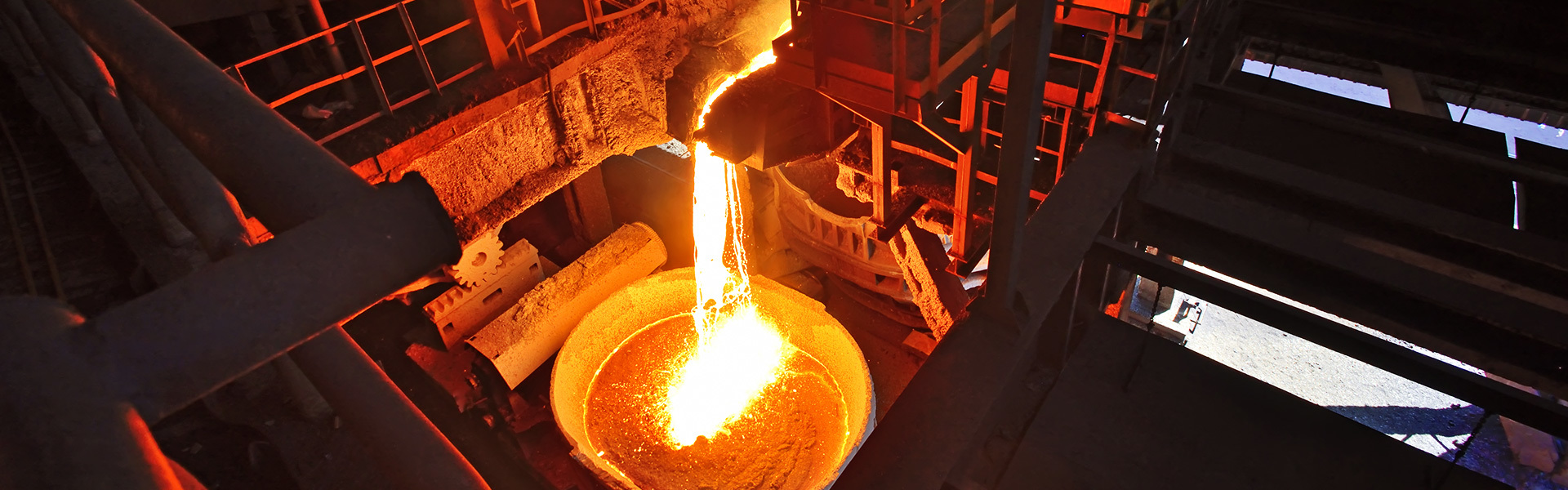

Steel Plate
1. Rolling: The 4-high reversible finishing mill with the maximum load of 7000 tons minimizes internal defects even in extremely thick plates. Automatic gauge control and shape control systems can reduce not only the thickness deviation of plates but also improve the flatness.
2. Cooling: The cooling system enables the production of high strength steel without heat treatment through rolling and accelerated cooling. Using the mist cooling method with suction type, the system has a high cooling capacity and is able to maintain a uniform temperature gradient in the widthwise direction. This leads to a reduction of plate quality deviation.
3. Hot Leveling: The hot leveler is used to make superior quality flat plates by eliminating residual stress left on rolled plates.
4. Slitting: After passing through the cooler, the plates undergo a dimensional accuracy inspection and then cut into appropriate width and length according to plate grade and thickness using either mechanical shearing machine or flame planner. To obtain a higher degree of dimensional accuracy in products, production conditions are determined by such factors as the air knife gap and the nozzle size of the gas torch.
5. Heat Treatment: To attain the plate structure demanded by customers, plates undergo heat treatment after having the scale removed by shot blasters. The heat treating facilities are of a non-oxidizing radiation tube type, which produces scale-free heat-treated plates.
6. Ultrasonic Tester Checks: The ultrasonic tester checks for blow holes, pipes, and laminations and other internal defects. This test is performed to guarantee the internal quality of plates demanded by customers.
View Video
2. Cooling: The cooling system enables the production of high strength steel without heat treatment through rolling and accelerated cooling. Using the mist cooling method with suction type, the system has a high cooling capacity and is able to maintain a uniform temperature gradient in the widthwise direction. This leads to a reduction of plate quality deviation.
3. Hot Leveling: The hot leveler is used to make superior quality flat plates by eliminating residual stress left on rolled plates.
4. Slitting: After passing through the cooler, the plates undergo a dimensional accuracy inspection and then cut into appropriate width and length according to plate grade and thickness using either mechanical shearing machine or flame planner. To obtain a higher degree of dimensional accuracy in products, production conditions are determined by such factors as the air knife gap and the nozzle size of the gas torch.
5. Heat Treatment: To attain the plate structure demanded by customers, plates undergo heat treatment after having the scale removed by shot blasters. The heat treating facilities are of a non-oxidizing radiation tube type, which produces scale-free heat-treated plates.
6. Ultrasonic Tester Checks: The ultrasonic tester checks for blow holes, pipes, and laminations and other internal defects. This test is performed to guarantee the internal quality of plates demanded by customers.
Forging Steel
1. Heating: Pre-forged metal starts with metal blocks called "ingots," which come in a variety of shapes and sizes depending on the part or component to be produced. These ingots are heated to a near molten state where the metal still retains its shape but can be altered easily with force.
2. Preforming: In order to form a piece of the ingot to be pressed between the closed dies, the heated ingot is edged and blocked with a press or hammer. Edging is done to increase the working cross section and blocking is implemented to refine the shape for finish forging.
3. Finish Forging: To complete the shape, the preformed metal is forced into an impression between two dies; this is where the metal takes on the general shape of the end product. Simple items may only need one press, but more complicated items may require multiple strokes at different pressures or even different dies to design the final product.
4. Cooling: By coordinating the cooling of the metal, forgers can increase the strength of the final product by deforming and optimizing the grain flow within the metal. A unique aspect of impression die forging is the "flash," which is the excess metal that flows outside of the dies. The flash cools and hardens rapidly causing it to be stronger than the metal in the dies. This forces the metal in the dies to completely fill any cavities.
5. Finishing: Once a forged product has gone through the pressing process, trimming and other surface treatment operations are performed in order to improve the dimensional accuracy of the forged product. Surface treatment can be completed to enhance corrosion resistance and improve the appearance of the finished forged product.
View Video
2. Preforming: In order to form a piece of the ingot to be pressed between the closed dies, the heated ingot is edged and blocked with a press or hammer. Edging is done to increase the working cross section and blocking is implemented to refine the shape for finish forging.
3. Finish Forging: To complete the shape, the preformed metal is forced into an impression between two dies; this is where the metal takes on the general shape of the end product. Simple items may only need one press, but more complicated items may require multiple strokes at different pressures or even different dies to design the final product.
4. Cooling: By coordinating the cooling of the metal, forgers can increase the strength of the final product by deforming and optimizing the grain flow within the metal. A unique aspect of impression die forging is the "flash," which is the excess metal that flows outside of the dies. The flash cools and hardens rapidly causing it to be stronger than the metal in the dies. This forces the metal in the dies to completely fill any cavities.
5. Finishing: Once a forged product has gone through the pressing process, trimming and other surface treatment operations are performed in order to improve the dimensional accuracy of the forged product. Surface treatment can be completed to enhance corrosion resistance and improve the appearance of the finished forged product.
3D Virtual Pavilion
Douyin Official Media
Flagship Micro Mall
WeChat Public Number
SAF Coolest v1.3 设置面板 XXOSX-ZVJY-HDASE-ZVD
违禁词: First, best, first-class, leading, unique, king, leader, leader, extreme,